


A practical guide for financial advisors and their clients demystifying one of the fastest-growing corners of private markets.
Q1. What are private credit secondaries and how do they differ from primary investments?
When an investor commits to a private credit fund at launch, capital is deployed before any loans have been made. The investor is trusting the manager to put that money to work wisely over the months and years ahead. This is a primary investment, and it carries what practitioners call blind pool risk: at the time of commitment, you don’t yet know exactly what you’ll own.
A private credit secondary investment works on a fundamentally different premise. Rather than investing at inception, you are purchasing an existing stake in a fund or portfolio of loans from an investor who already holds it. The loans have been made. Borrowers are already making interest payments. There is a visible track record to evaluate.
The analogy that resonates most clearly: it is the difference between backing a horse before you have seen it train versus placing your bet at the halfway point of the race, when you can already see which horse is leading and which are fading behind. You are stepping into a portfolio that is already generating income, with considerably more information than was available at the outset.
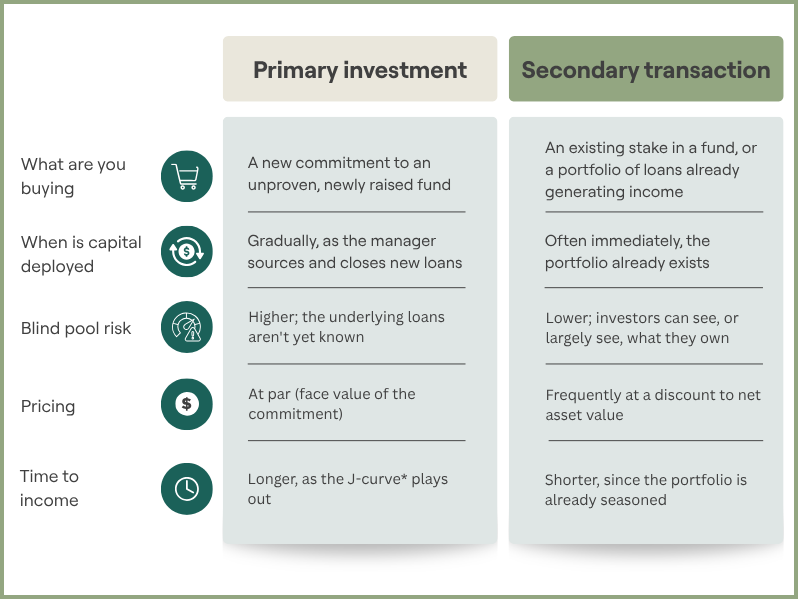
*The J-curve represents the tendency of funds to post negative returns in the early years due to investment costs, management fees, and immature portfolios, followed by increasing returns as investments mature and profitable ventures generate gains
Q2. What are the most common types of secondaries transactions?
There are two primary transaction structures, and understanding both helps advisors and clients appreciate the full range of opportunities within the strategy.
The first is an LP-led transaction. Here, an existing investor in a credit fund, known as a limited partner, decides to sell their stake to a secondary buyer. The buyer steps into that investor’s position and inherits the remaining income stream and return potential of the portfolio. This structure tends to offer clear visibility into what is being purchased, along with straightforward pricing dynamics.
The second is a GP-led transaction. In this case, the fund manager, known as the general partner, proactively structures a transaction. This often involves the creation of a new vehicle, called a continuation fund, which is designed to extend the life of a well-performing portfolio or provide an exit option to investors who want one. Existing investors are typically offered a choice: sell to secondary buyers at an agreed price or roll their stakes into the new vehicle and continue participating in the portfolio’s upside.
Both structures can offer attractive characteristics within a secondary portfolio. LP-led deals tend to emphasize pricing discipline and simplicity. GP-led transactions can reflect a high degree of manager conviction in assets that still have meaningful runways of growth ahead of them.
Q3. Why would an investor sell their stake in a primary fund?
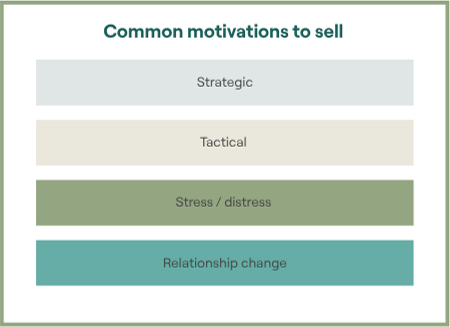 Investors sell existing positions for a wide range of reasons, most of which have little to do with the quality of the underlying loans. A pension fund may need to rebalance its allocation. An institution may be restructuring its alternatives program. A bank may face regulatory requirements that make certain holdings less practical to retain. In each case, motivation is typically a liquidity need, not a judgment that the assets are unattractive.
For a secondary buyer, this creates a genuine opportunity. Because the seller is motivated to transact, and because private credit positions do not trade freely on an exchange, purchases can often occur at a discount to the fund’s net asset value. That discount can translate directly into improved yield and stronger total return potential for the buyer, layered on top of the income the underlying loans are already producing.
It is a structural feature of the market. The secondary buyer is providing something the seller genuinely needs, which is liquidity, and is compensated for doing so through pricing that reflects that service.
Q4. How large is the private credit secondaries market and what is the go-forward opportunity set?
The private credit secondaries market has undergone a remarkable transformation in a short period of time, moving from a niche solution for distressed sellers into a deliberate, repeatable tool used by the most sophisticated allocators in private markets.
Total transaction volume reached $20 billion in 2025, nearly doubling from $11 billion the prior year – and that momentum has only accelerated. Transaction volume in the first half of 2026 alone already matched the entirety of 2025, coming in at approximately $20 billion. Yet despite the pace of growth, Coller estimates that the market remains at under 1% secondary penetration of a $4 trillion addressable universe. The opportunity set is large, and the market is moving faster than ever.
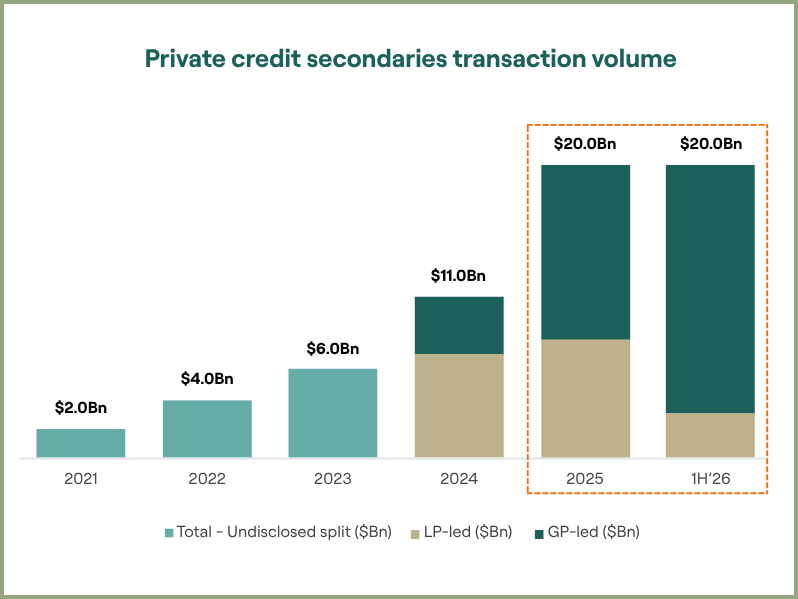
Source: Evercore 1H26 Secondary Market Review, July 2026.
Q5. How does the return profile compare to other income-oriented strategies?
Private credit secondaries start from the return profile of primary direct lending and add a further premium on top. Coller estimates that private credit secondaries have historically delivered a 150–200 basis point return premium over primary direct lending, driven by discounted entry pricing, a seasoned and already-generating portfolio, and faster capital return. Set against other income-oriented asset classes, the strategy screens attractively on a risk-adjusted basis — offering a meaningfully higher illustrative return than public credit alternatives such as high yield bonds and broadly syndicated loans, and a substantial premium over 10-year treasuries.
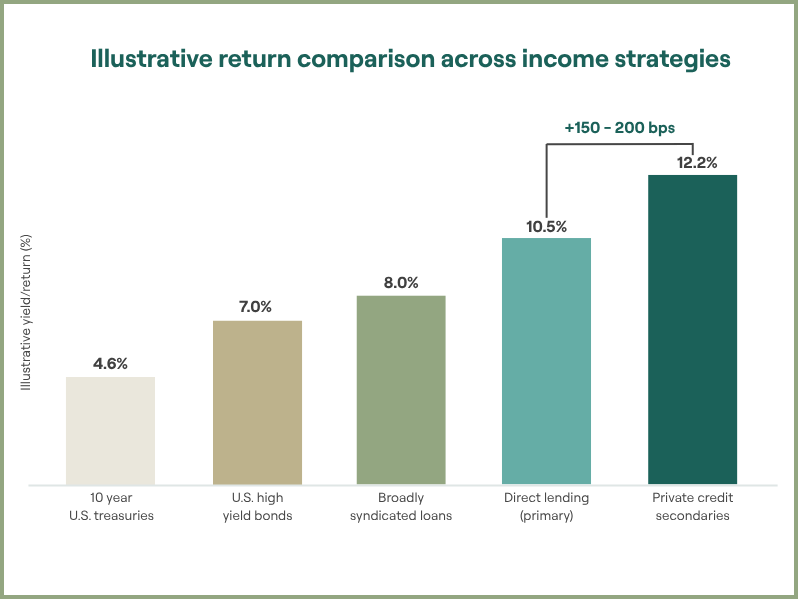
Sources: U.S. Department of the Treasury, 10-Year Treasury Constant Maturity Rate (July 2026); ICE BofA US High Yield Index, effective yield (July 2026); Morningstar LSTA US Leveraged Loan Index / PitchBook LCD, illustrative all-in yield (2026); Cliffwater Direct Lending Index, interest income component (2025 calendar year); Coller estimates for private credit secondaries (150–200 basis point premium over primary direct lending). For illustrative purposes only. Figures represent point-in-time index yields and Coller Capital estimates as of the dates noted and do not represent the performance of any specific fund, product, or investment. You cannot directly invest in an index. Actual returns will vary by manager, vintage, structure, and prevailing market conditions, and may differ materially from the illustration above. Past performance is no guarantee of future results.
Q6. Many of my clients have exposure to private credit through primary funds. Why should they consider a secondary allocation?
Primary fund commitments are naturally concentrated — a single vintage, a single strategy, a handful of underlying loans built up gradually over years. Private credit secondaries work differently and complement that primary exposure rather than replace it.
- Diversification: a single secondary purchase typically provides exposure across dozens of underlying managers, vintages, and hundreds of loans — meaningfully broadening a portfolio otherwise concentrated in a handful of primary commitments.
- Risk-adjusted returns: because purchases are typically made at a discount to net asset value, secondaries have a history of delivering higher risk-adjusted returns than primary strategies.
- Reduced blind pool risk and J-curve: the underlying portfolio is already seasoned and generating income, which lowers blind pool risk and shortens the J-curve, translating into faster distributions than a new primary fund can offer.
For clients already committed to primary private credit, a secondaries allocation is not a substitute — it is the long-term core holding that diversifies, mitigates concentration risks, and accelerates the cash flow profile of the overall private credit program, while primary fund commitments continue to serve as targeted, satellite exposure.
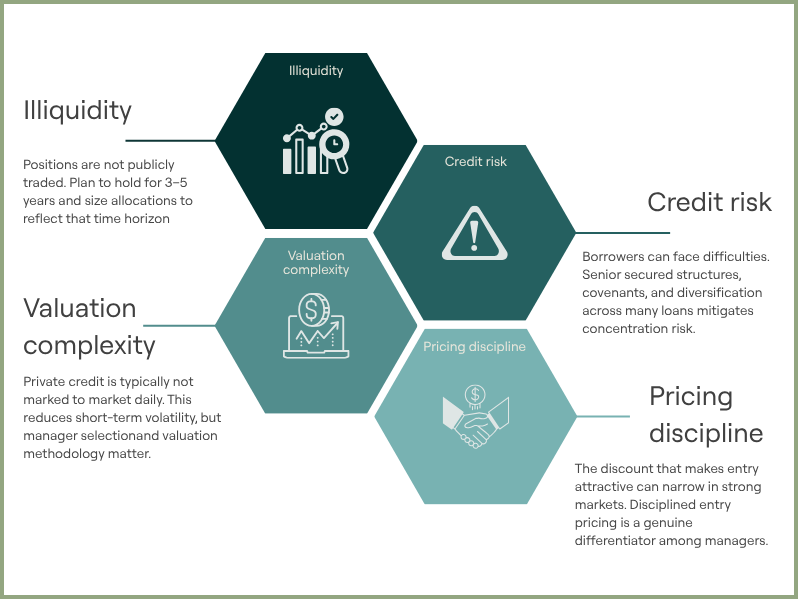
Q7. What are the key risks advisors and clients should understand before allocating?
Q8. How should advisors think about sizing an allocation?
While each client’s goals, time horizon, and risk tolerance are different, private credit secondaries tend to work best as a purposeful component of a broader alternatives allocation — complementing other holdings, not replacing them. They are not a substitute for liquid reserves or short-term income needs. Three questions help frame the conversation:
- Does it improve yield?
Without adding proportionate risk relative to other income alternatives already in the portfolio. - Does duration fit?
The short lifespan versus a primary fund mat align better with the client’s investment horizon. - Is the story cleaner?
Reduced blind pool risk often makes the client conversation more straightforward than a primary commitment.
Key takeaways
Private credit secondaries are moving quickly from a niche tool to a core portfolio component. Five points to keep in mind:
- Lower blind pool risk, shorter J-curve: secondaries buy into seasoned, already-generating portfolios, so capital is put to work faster than in a new primary commitment.
- A structural discount, not a distressed one-off: purchases are typically made at a discount to net asset value because sellers need liquidity, not because the assets are unattractive, generating a repeatable source of return for buyers.
- Large and still early: transaction volume reached $20 billion in 2025, yet the market remains under 1% penetrated of a $4 trillion addressable universe.
- An attractive return profile: Coller estimates secondaries have historically delivered a 150–200 basis point premium over primary direct lending, representing a meaningful step up from public credit alternatives and Treasuries.
- Best used as a core, not a swap: secondaries typically work best as a long-term core holding that diversifies and complements primary fund commitments, sized around each client’s liquidity needs and time horizon.